Bag Filter for Cement Kilns: Selection Guide
Einführung
The cement kiln is the largest source of particulate emissions within a cement manufacturing facility and typically accounts for the highest gas flow rates, dust loading conditions, and filtration challenges. As environmental regulations become increasingly stringent and operational efficiency becomes a key business driver, selecting the right bag filter system has become a strategic investment rather than a simple compliance requirement.
For procurement managers, the challenge is balancing capital expenditure, operating cost, emission guarantees, maintenance requirements, filter bag life, and future environmental compliance. A poorly selected bag filter can result in excessive pressure drop, frequent bag failures, production losses, and expensive shutdowns.
This guide outlines the critical engineering criteria used to select a bag filter for cement kiln applications and explains how modern pulse jet baghouses outperform conventional technologies in today’s cement plants.
Why Cement Kilns Require Specialized Dust Collection Systems
Cement kiln exhaust gases are significantly more challenging than those found in many industrial processes.
Typical kiln exhaust characteristics include:
- ✓High gas volume
- ✓Elevated operating temperatures
- ✓Abrasive particulate matter
- ✓Variable dust loading
- ✓Alkali-rich dust chemistry
- ✓Sulfur compounds
- ✓Moisture fluctuations
- ✓Frequent process variations
These conditions demand filtration systems specifically designed for continuous heavy-duty operation.
Typical Cement Kiln Dust Characteristics
| Parameter | Typical Range |
|---|---|
| Staubbelastung | 20–200 g/Nm³ |
| Partikelgröße | 0.5–100 μm |
| Gas Temperature | 110–200°C |
| Gas Volume | 250,000–1,000,000 Nm³/hr |
| Moisture Content | 5–15% |
| Staubart | Abrasive & Alkaline |
Key Engineering Criteria for Bag Filter Selection
1. Gas Flow Rate Assessment
The first design parameter is the kiln exhaust gas volume.
The total gas flow determines:
- ✓Baghouse size
- ✓Number of compartments
- ✓Fan capacity
- ✓Filter area requirements
Typische Werte:
| Kiln Capacity | Gas Flow |
|---|---|
| 3000 TPD | 250,000–350,000 Nm³/hr |
| 5000 TPD | 400,000–550,000 Nm³/hr |
| 10000 TPD | 700,000–1,000,000 Nm³/hr |
Underestimating gas volume often results in excessive air-to-cloth ratio and reduced bag life.
2. Air-to-Cloth Ratio (A/C Ratio)
The Air-to-Cloth Ratio is one of the most important selection parameters.
For cement kiln applications:
| Anwendung | Recommended A/C Ratio |
|---|---|
| Standard Kiln Filter | 0.9–1.2 m/min |
| High-Efficiency Design | 0.8–1.0 m/min |
| Ultra-Low Emission Plants | 0.7–0.9 m/min |
Lower filtration velocities generally provide:
- ✓Geringere Emissionen
- ✓Längere Lebensdauer der Tasche
- ✓Niedrigerer Differenzdruck
- ✓Reduced compressed air consumption
3. Dust Loading Evaluation
Dust concentration at the bag filter inlet directly impacts sizing and cleaning requirements.
Sources affecting dust loading include:
- ✓Raw mill operation
- ✓Conditioning tower performance
- ✓Cyclone efficiency
- ✓Kiln operating conditions
Higher dust loading requires:
- ✓Larger hopper volume
- ✓Improved cleaning system
- ✓Increased filtration area
Cement Kiln Dust Collection Process
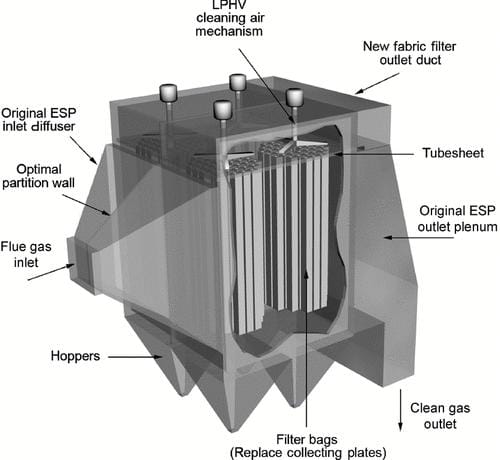
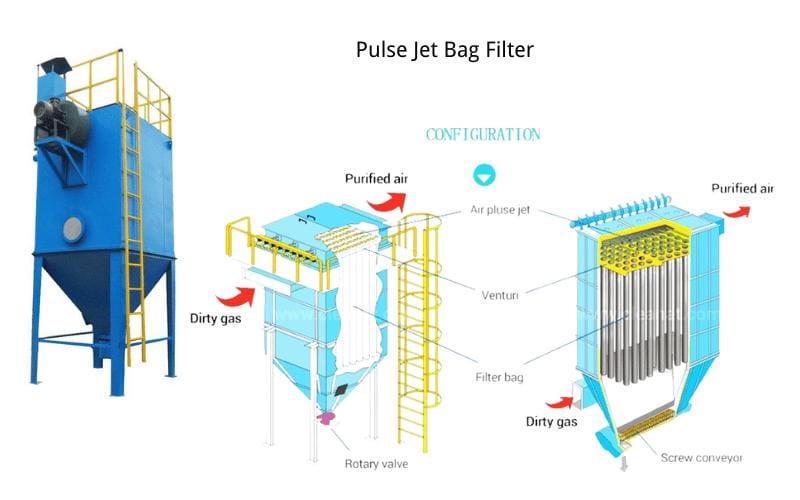
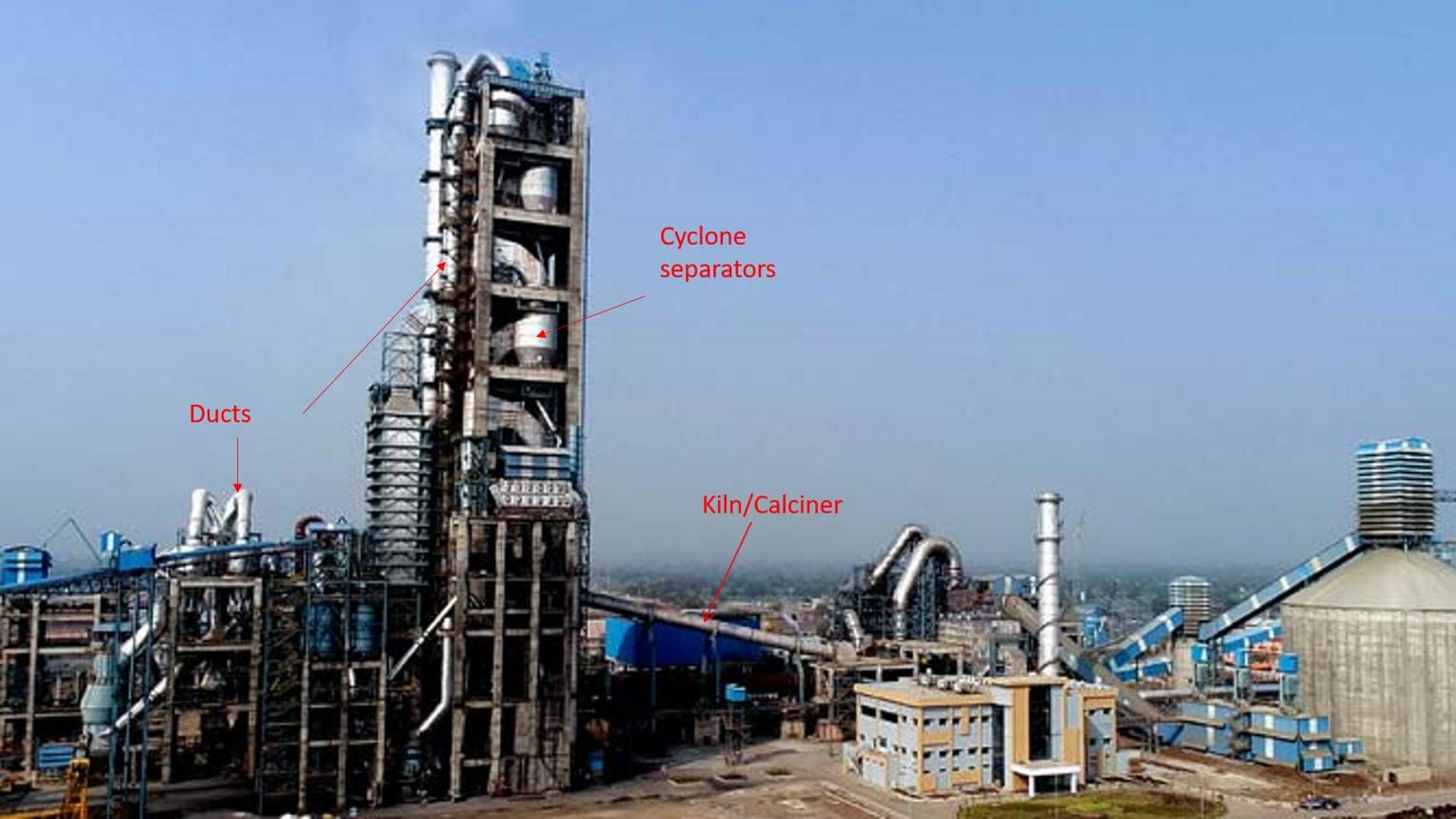
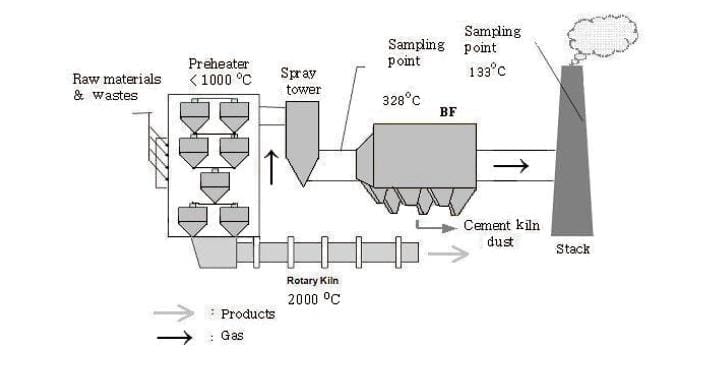
A typical cement kiln filtration system includes:
Cyclone Pre-Separator
The cyclone removes coarse particles before the gas enters the baghouse.
Benefits include:
- ✓Reduced dust loading
- ✓Lower filter wear
- ✓Reduced maintenance cost
- ✓Improved bag life
Pulse-Jet-Beutelfilter
The bag filter captures fine particulate matter and ensures compliance with emission regulations.
Filter Media Selection for Cement Kilns
Filter bag material selection significantly impacts operational performance.
PPS (Ryton)
Suitable for:
- ✓Continuous temperatures up to 190°C
- ✓Moderate acid gas concentrations
- ✓Cement kiln exhaust applications
Vorteile:
- ✓Excellent chemical resistance
- ✓Good temperature capability
- ✓Proven kiln performance
Aramid (Nomex)
Vorteile:
- ✓High temperature resistance
- ✓Good mechanical strength
- ✓Suitable for dry kiln conditions
Einschränkungen:
- ✓Less resistance to acidic environments
Glasfaser
Typically selected for:
- ✓Large cement kiln installations
- ✓High-temperature operations
- ✓Demanding process conditions
Vorteile:
- ✓Excellent dimensional stability
- ✓Lange Lebensdauer
PTFE Membrane Laminated Filter Bags
Increasingly preferred in modern cement plants.
Benefits include:
- ✓ Lower emissions
- ✓ Better dust cake release
- ✓ Lower differential pressure
- ✓ Improved cleaning efficiency
- ✓ Longer operational life
Pulse Jet Cleaning System Selection
The cleaning system directly affects bag performance and maintenance cost.
Critical components include:
- ✓Solenoid valves
- ✓Pulse valves
- ✓Air headers
- ✓Blow pipes
- ✓Compressed air system
A properly designed pulse cleaning system maintains stable differential pressure while minimizing compressed air consumption.
Hopper Design Considerations
Many baghouse failures originate in hopper design rather than filter media.
Key requirements include:
- ✓Steep wall angles (>60°)
- ✓Anti-ratholing design
- ✓Proper dust evacuation
- ✓Continuous discharge
Recommended equipment:
- ✓Rotary Airlocks
- ✓Screw Conveyors
- ✓Double Dump Valves
Emission Guarantee Requirements
Modern cement plants increasingly target emissions below traditional regulatory limits.
| Performance Level | Emission Target |
|---|---|
| Standard Compliance | <30 mg/Nm³ |
| Best Practice | <10 mg/Nm³ |
| World-Class Plants | <5 mg/Nm³ |
Achieving these levels requires:
- ✓Proper bag selection
- ✓Low air-to-cloth ratio
- ✓Effective pulse cleaning
- ✓Continuous monitoring
ESP vs Bag Filter: Which is Better?
| Parameter | ESP | Beutelfilter |
|---|---|---|
| Feinstaubabscheidung | Mäßig | Exzellent |
| Low Load Operation | Variable | Consistent |
| Emission Performance | Mäßig | Vorgesetzter |
| Future Compliance | Challenging | Einfacher |
| Retrofit Potential | Beschränkt | Hoch |
| PM Removal Efficiency | 95–99% | >99,9% |
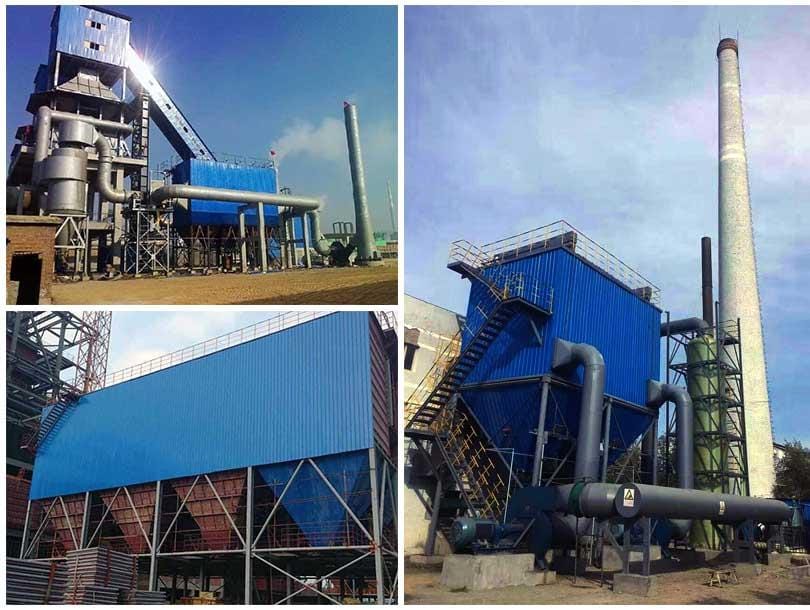
Many cement plants are replacing ESP systems with bag filters to meet stricter environmental regulations and reduce operational variability.
Procurement Checklist for Cement Kiln Bag Filters
Before issuing a purchase order, verify:
Process Data
- ✔ Gas flow rate
- ✔ Dust loading
- ✔ Operating temperature
- ✔ Dew point
- ✔ Particle characteristics
Equipment Design
- ✔ Air-to-cloth ratio
- ✔ Number of compartments
- ✔ Hopper design
- ✔ Cleaning system
- ✔ Fan sizing
Commercial Evaluation
- ✔ Emission guarantee
- ✔ Filter bag warranty
- ✔ Spare parts availability
- ✔ Service support
- ✔ Lifecycle operating cost
Procurement decisions based solely on capital cost often lead to higher ownership costs over the equipment life cycle.
Common Selection Mistakes
Avoid the following:
- ❌ Choosing the lowest-cost supplier
- ❌ Ignoring future emission regulations
- ❌ Incorrect filter media selection
- ❌ Oversized filtration velocity
- ❌ Inadequate hopper design
- ❌ Poor compressed air quality
- ❌ Lack of maintenance access
- ❌ No provision for online maintenance
Why Cement Plants Prefer IFH Bag Filter Systems
Modern IFH bag filter systems are engineered to provide:
- ✓Low emissions
- ✓Hohe Sammelleistung
- ✓Optimized energy consumption
- ✓Long filter bag life
- ✓Robust cleaning systems
- ✓Reliable operation under fluctuating kiln conditions
- ✓Support for ESP-to-Bag Filter retrofit projects
Our systems are designed specifically for cement kiln applications where operational reliability and compliance performance are critical.
Abschluss
Selecting the right bag filter for a cement kiln requires a detailed evaluation of process conditions, dust characteristics, filtration velocity, filter media, cleaning systems, and future compliance requirements. While many suppliers focus on equipment cost alone, the true value lies in lifecycle performance, maintenance savings, energy efficiency, and emission reliability.
For procurement managers, investing in a properly engineered pulse jet bag filter with suitable filter media and optimized design parameters delivers lower operating costs, longer bag life, reduced downtime, and sustainable environmental compliance.
Häufig gestellte Fragen (FAQ)
What is the best bag filter for a cement kiln?
Pulse jet bag filters are generally considered the most effective solution due to their high efficiency, continuous operation, and ability to handle varying kiln conditions.
What filter media is recommended for cement kiln applications?
PPS, Fiberglass, Aramid, and PTFE membrane laminated bags are commonly used depending on temperature, dust chemistry, and emission requirements.
Why are cement plants replacing ESPs with bag filters?
Bag filters provide superior fine-particle capture, lower emissions, and more stable performance under varying operating conditions.
What is the ideal air-to-cloth ratio for a cement kiln bag filter?
Most cement kiln baghouses operate between 0.8 and 1.2 m/min, depending on performance targets.
How long do cement kiln filter bags last?
With proper design and maintenance, filter bags can typically last 3–6 years depending on operating conditions and media selection.
Download the Cement Kiln Bag Filter Selection Guide
Free Technical PDF Guide
Learn:
- ✓Baghouse sizing fundamentals
- ✓Filter media selection matrix
- ✓Air-to-cloth ratio calculations
- ✓ESP retrofit considerations
- ✓Procurement checklist
 DE
DE  EN_US
EN_US  UR
UR  AR
AR  NL
NL  MS
MS  FR
FR  IT
IT  FA
FA  VI
VI  KO
KO  RU
RU  ID
ID  FIL
FIL  KK
KK  UZ
UZ  BG
BG  CS
CS  HU
HU  SL
SL  SV
SV  PL
PL  TR
TR  FI
FI  ES
ES