

The efficiency of an industrial dust collector forms the unseen foundation of operational safety, environmental compliance, and long-term cost efficiency. It safeguards production quality, protects equipment, and ensures a healthier working environment. However, many industries continue to struggle with performance issues caused by outdated, poorly maintained, or mismatched filtration systems. These inefficiencies often translate into higher energy consumption, frequent maintenance, and reduced system reliability.
في فلتر مكثف هيمنفيرو, a trusted global leader in industrial air pollution control, we recognize that a dust collector’s true performance lies not in its size or design alone, but in the quality and engineering of its filter cartridge. The cartridge is the heart of the system—responsible for determining filtration efficiency, energy use, and maintenance frequency.
This article explores the core challenges industries face in dust collection and demonstrates how the advanced filter cartridge offers a transformative solution—delivering superior efficiency, durability, and adaptability through advanced technical, mechanical, and functional innovation.
The Problem: Operational Bottlenecks in Industrial Dedusting
Industrial operations such as cement manufacturing, metal fabrication, and chemical or pharmaceutical processing generate significant amounts of airborne particulate matter. Managing this dust efficiently is not only an environmental concern but also a productivity challenge. Traditional filtration systems often fall short in three major areas: airflow management, maintenance efficiency, and fine particulate capture.
1. Airflow Restriction and Pressure Drop
Older filter systems—whether bags or early cartridge types—tend to clog quickly. As dust accumulates on the media, the differential pressure (ΔP) across the filter rises. To maintain airflow, the system’s fan must work harder, increasing energy consumption and operational costs. If ΔP exceeds safe limits, the collector’s efficiency declines sharply, risking compliance failures and potential health hazards.
2. Maintenance, Downtime, and Space Constraints
Conventional baghouses require large physical space and extensive maintenance. Their design demands complex filter replacement processes, often involving confined space entry, which leads to prolonged shutdowns and higher maintenance costs. Moreover, their larger air-to-cloth ratio means a bulkier structure for the same airflow performance—an issue for modern plants that value compact, integrated systems.
3. Poor Fine Dust Filtration
With increasingly stringent environmental and workplace safety standards, especially concerning PM2.5 and hazardous dusts, the need for precision filtration is critical. Traditional filters often fail to reach near-HEPA efficiencies, allowing submicron particles to escape. Furthermore, using inappropriate media for specific dust types—such as sticky, fibrous, or abrasive particulates—leads to premature filter failure and inconsistent performance.

Ensure Clean Air and Regulatory Compliance Today
The Solution: Advanced Cartridge Filter Technology
Modern pleated cartridge filters from Intensiv Filter Himenviro represent a breakthrough in dust collection, addressing each of these pain points with precision-engineered design and material science.
Superior Surface Area, Compact Design
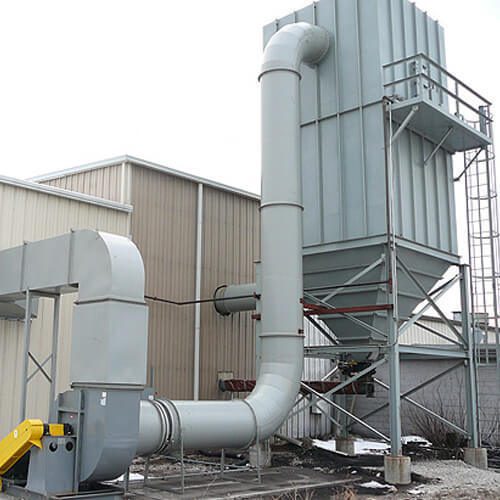
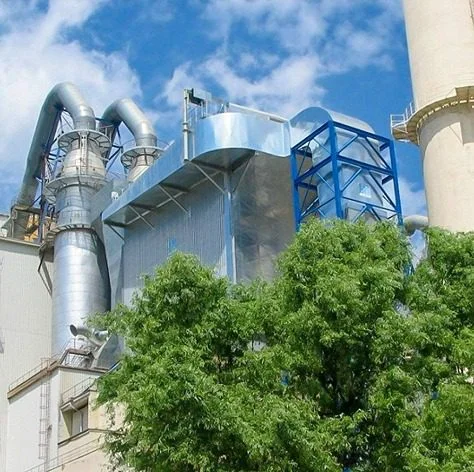
The pleated structure of cartridge filters allows a much greater filtration surface area within a compact cylindrical form. This design dramatically reduces the air-to-cloth ratio, enabling the same airflow capacity in a collector that can be up to 70% smaller than a traditional baghouse. The result is a cleaner, space-efficient system ideal for integration into production lines or facilities with spatial limitations.
Optimized Cleaning and Pressure Stability
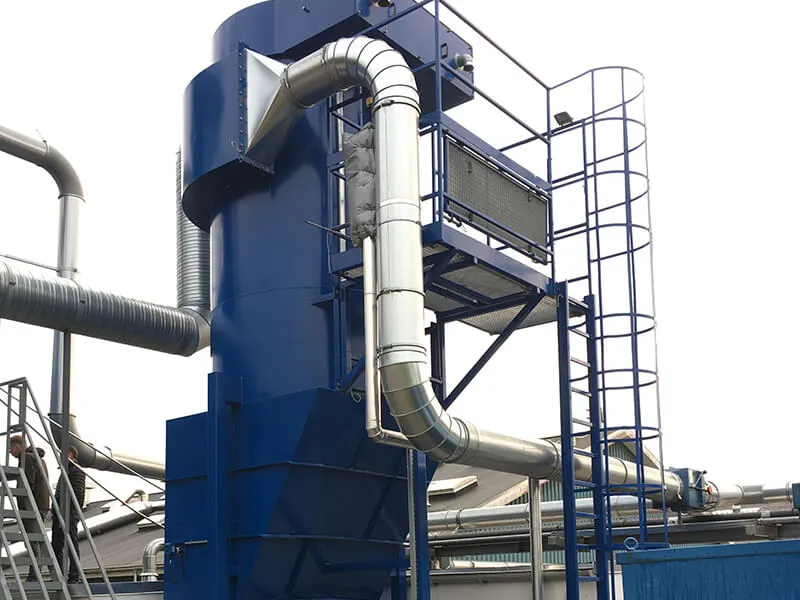
Cartridge collectors employ a refined reverse pulse-jet cleaning mechanism. A controlled burst of compressed air travels through the cartridge’s center, creating a shockwave that dislodges accumulated dust without damaging the media. Intensiv Filter Himenviro’s cartridges feature advanced media coatings—such as nanofiber technology—that prevent dust penetration into the fiber structure. This ensures surface-level filtration, easy dust release, and consistently low ΔP. The outcome is longer filter life, reduced energy usage, and stable airflow.
Application-Specific Media Selection
Every industrial process produces dust with unique physical and chemical characteristics. Selecting the right filter media is therefore critical. Intensiv Filter Himenviro provides customized solutions for diverse environments, ensuring optimum performance, durability, and compliance.
Dust Type / Environment | Recommended Cartridge Media | Technical Feature & Benefit |
|---|---|---|
Fine, Submicron Dust | وسائط الألياف النانوية | Delivers surface loading efficiency, achieving up to MERV 15/16 for ultra-fine particle capture. |
Abrasive or Coarse Dust | Spunbond Polyester | Provides exceptional mechanical strength and wear resistance, ideal for tough operating conditions. |
Moist or Oily Dust | Oleophobic/Hydrophobic Coated Media | Repels moisture and oil, preventing filter blinding and maintaining consistent airflow. |
Explosive or Combustible Dust | Antistatic/Flame Retardant Media | Incorporates conductive elements to safely dissipate static charge and ensure NFPA compliance. |
Reduced Maintenance and Improved Safety
One of the greatest operational advantages of modern cartridge collectors lies in their simplified maintenance. Many systems are designed for clean-side access and tool-free cartridge replacement. This eliminates the need for workers to enter the dirty air plenum, reducing downtime from hours to minutes and significantly enhancing safety compliance. These design improvements also contribute to better overall equipment effectiveness (OEE) and reduced lifecycle costs.
اكتشف مجموعة الحلول لدينا:

Reimagining Industrial Dedusting
Transitioning to advanced cartridge filter technology marks a defining shift in how industries approach air pollution control. What was once considered a necessary maintenance task can now become a true performance enhancer. Modern cartridge filters redefine dust collection by merging compact engineering, superior filtration efficiency, and reduced operational effort into one cohesive system.
Unlike traditional baghouses, which often demand large footprints and frequent intervention, cartridge-based systems deliver continuous, stable performance with minimal downtime. Their pleated design not only maximizes filtration surface area but also maintains a lower differential pressure, ensuring consistent airflow and significant energy savings. The result is a cleaner process, extended filter life, and reduced total cost of ownership.
في فلتر مكثف هيمنفيرو, innovation is driven by a clear purpose—to make industrial dedusting systems smarter, safer, and more sustainable. Drawing on decades of engineering expertise, we design filtration solutions that address real-world industrial challenges across sectors such as cement, metal processing, power generation, and pharmaceuticals.
The next generation of industrial dedusting is built on precision and performance. It’s not just about meeting compliance standards—it’s about creating systems that actively enhance productivity, protect worker health, and contribute to a cleaner, more efficient future for every industry we serve.

الأسئلة الشائعة
A filter cartridge dust collector operates by drawing dust-laden air into the unit, typically using an induced-draft fan. This air is forced through multiple pleated, cylindrical cartridge filters, which trap the particulate matter on their outer surface. The clean air then exits the collector. To prevent filter clogging and maintain continuous airflow, the system employs a pulse-jet cleaning mechanism. This periodically injects a short, high-pressure burst of compressed air inside the cartridge, causing the accumulated dust cake to dislodge and fall into a hopper for disposal.
Cartridge dust collectors generally offer significant benefits over older baghouse designs. The primary advantage is their smaller footprint, as the pleated design of the cartridges provides a much larger filtration surface area in a compact space compared to long fabric bags, making them ideal where floor space is limited. Additionally, cartridge filters often achieve higher filtration efficiency, capturing finer dust particles more effectively. Finally, maintenance is typically simpler and quicker because cartridges are generally easier to access and replace than heavy, secured fabric bags.
The critical indicator for filter replacement is the differential pressure (DP) across the filters. This is the difference in air pressure measured before and after the filter media. As dust builds up, the DP increases, signalling reduced airflow. While the pulse-jet system is designed to keep the DP within an operational range, you must replace the cartridges when the DP remains consistently high even immediately after a cleaning cycle. A high, unmanageable DP means the airflow through the system is too low for effective dust capture at the source, or if visible emissions suddenly increase.
Poor performance in a cartridge collector is often traced to issues with the pulse-jet system or the dust type. The most frequent problems involve insufficient compressed air pressure or volume delivered to the pulse valves, which prevents the dust cake from being properly dislodged. Another major cause is the filter media becoming “blinded” or “caked,” which occurs when sticky, wet, or extremely fine dust embeds itself permanently into the filter fibers, rendering the cleaning pulse ineffective and permanently raising the differential pressure. Using the wrong filter media for a specific dust can also lead to premature failure.


 AR
AR  EN_US
EN_US  UR
UR  NL
NL  MS
MS  DE
DE  FR
FR  IT
IT  FA
FA  VI
VI  KO
KO  RU
RU  ID
ID  FIL
FIL  KK
KK  UZ
UZ  BG
BG  CS
CS  HU
HU  SL
SL  SV
SV  PL
PL  TR
TR  FI
FI  ES
ES